Will AI End the Legal Profession — Or Just Reinvent It?
- Admin ILTN
- Dec 24, 2025
- 3 min read

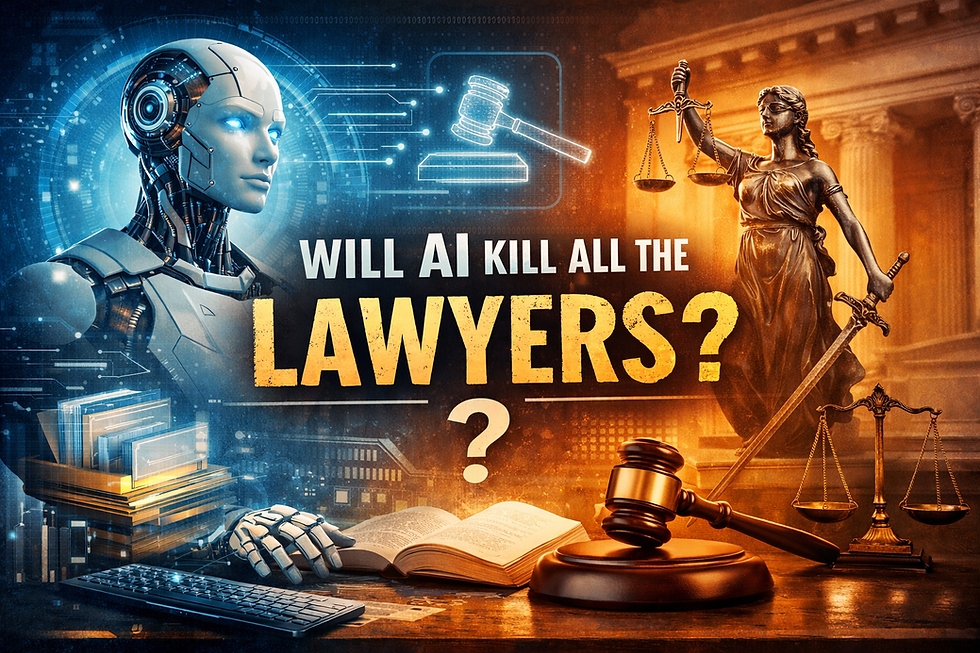
A senior barrister recently made waves with a deliberately incendiary claim: AI will “kill all the lawyers.” The article argued that artificial intelligence has already reached a point where it can outperform legal professionals — not just in speed, but in quality — and that this marks the beginning of the end for the profession.
The argument is effective as rhetoric. It taps into a real emotional current in law: the fear that a machine might one day replicate the skills lawyers spend decades refining. But the article’s logic leaps from AI can draft well to AI will replace lawyers entirely, using personal anecdote as the backbone of a universal prediction. That inference is not airtight. Capability does not automatically equal replacement, especially in professions where judgment, accountability, and ethics are core deliverables rather than side-features.
What AI Can Do Today
There is no denying that AI is rewriting legal workflows:
Contracts can be reviewed and redlined in minutes.
Case law research is faster and broader.
Drafting — from notices to agreements — is increasingly template-accurate.
Industry estimates suggest that a majority of routine legal work is now automatable, and firms that ignore AI risk falling behind. This signals a dramatic shift in how legal work is produced.
What AI Still Can’t Do
Yet, the claim that AI will make lawyers obsolete collapses when tested against the actual responsibilities of a legal professional:
Who takes responsibility when the advice is wrong? AI cannot hold a practicing license, be sanctioned by a court, or carry professional liability.
Can AI deliver contextual judgment? Not consistently. Courts across jurisdictions have already warned lawyers against relying on AI without verification, after instances of fabricated case citations and legal hallucinations.
Does AI replace client trust? Trust is not a data output. It is relational, strategic, emotional, and built over time — something AI supports but does not originate.
So while AI is strong at text production, it remains weak at truth verification, ethical ownership, and real-world consequence management.Yet, the claim that AI will make lawyers obsolete collapses when tested against the actual responsibilities of a legal professional:
Who takes responsibility when the advice is wrong? AI cannot hold a practicing license, be sanctioned by a court, or carry professional liability.
Can AI deliver contextual judgment? Not consistently. Courts across jurisdictions have already warned lawyers against relying on AI without verification, after instances of fabricated case citations and legal hallucinations.
Does AI replace client trust? Trust is not a data output. It is relational, strategic, emotional, and built over time — something AI supports but does not originate.
So while AI is strong at text production, it remains weak at truth verification, ethical ownership, and real-world consequence management.
The Real Disruption: Jobs or Business Models?
A more honest reading of the landscape suggests the risk to lawyers is not that AI will practice law, but that:
Law firms may redesign staffing around AI efficiency, shrinking teams for repetitive tasks.
The billable hour model could face pressure as AI reduces time spent on work that was previously monetized by duration rather than value.
Lawyers who treat AI as a threat rather than infrastructure might be left competing with those who adopt it early and strategically.
This means the real question isn’t Can AI do the work? but rather:
What parts of legal work are valued for expertise, and what parts were valued simply because they were slow?
What the Future Lawyer Looks Like
The lawyers who thrive in the AI era are likely to be those who become:
Verifiers, not just drafters
Strategists, not just researchers
Risk owners, not just text generators
Problem solvers who understand both law and technology
In other words, AI is not deleting the lawyer — it is deleting the amateur lawyer who never evolved beyond copy-paste work.
Why Hyperbolic Claims Still Matter
Even if the original argument overstates the case, it serves an important purpose: it forces the profession to confront its blind spots. Many LinkedIn practitioners responded with a similar sentiment — not rejecting the transformation, but rejecting the fatalism.
Their consensus: AI will change everything, but it won’t end everything.
Your Turn
So now we pass the baton to you:
Is it logical to extrapolate today’s AI drafting ability into total professional extinction?
Can a system without legal accountability ever fully replace one that carries ethical and regulatory responsibility?
If AI removes the repetitive work, what new skills will make lawyers indispensable?
Will AI kill all the lawyers — or simply kill the outdated version of the job? Where do you stand? More importantly — why?
Share your perspective, email contact@indianlegaltech.net. Let’s refine not just the conclusions, but the reasoning that builds them.


Comments