Waymakers Wednesday: Women in LegalTech – Meet Sohini Shrivastav

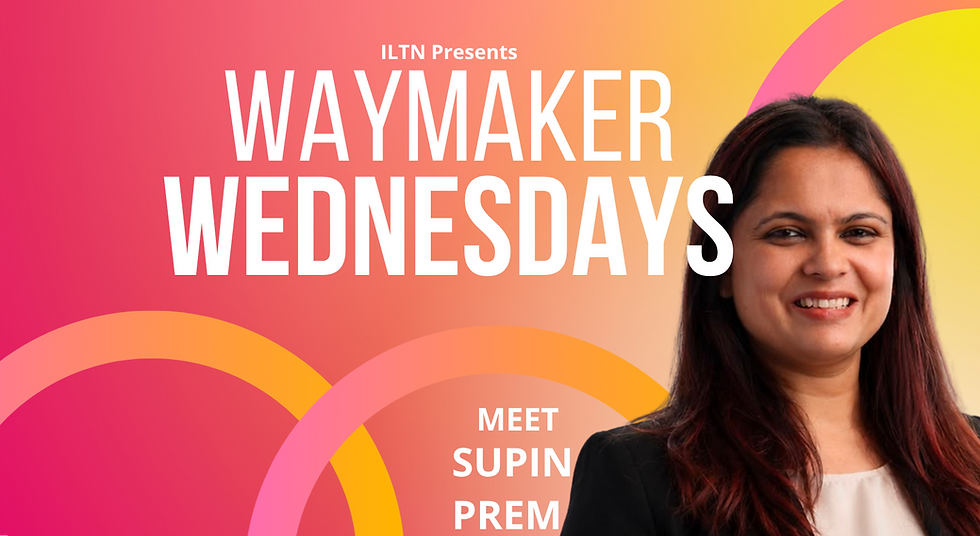
This week, our Waymaker Wednesdays spotlight shines on Sohini Shrivastav, Founding Member – Growth & Partnerships at Axara AI. Based in Mumbai, Sohini is a legal tech entrepreneur, educator, and researcher who is redefining how AI and technology can be integrated into legal practice and academia. She is also an active member of the Women in LegalTech community under ILTN.

Here’s a peek into her world:
1. What inspired you to join the Women in LegalTech community?
As someone who transitioned from corporate law to academia and now to legal tech entrepreneurship, I’ve experienced firsthand how underrepresented women are in STEM, in legal leadership, in conversations about technology and innovation in law. Joining the Women in Legal Tech community was about creating visibility, but also about finding solidarity. It’s inspiring to exchange experiences with women who are shaping the future of legal-tech in India and breaking stereotypes along the way. I wanted to be part of a network that amplifies women’s voices, encourages collaboration, and paves the way for the next generation of female leaders in legal tech.
I remember a simple question on whether we have directly or indirectly faced bias in our career literally set the group on fire. There were so many stories to share, so many insights to gain and there was overall so much camaraderie.
2. If you could solve one problem in the legal world (or beyond) with technology, what would it be?
If I could solve one problem, it would be sentencing disparities in sexual assault cases. This is the focus of my PhD research, where I analysed 176 judgments across 20+ factors such as age, time, post assault behaviour, socio-economic background, and victim-perpetrator relationship etc.. The absence of structured sentencing guidelines often leads to inconsistent and outcomes. With AI, we can identify patterns, build AI based predictive models, and provide judges and prosecution with data-driven insights to make sentencing more consistent, transparent, and fair. Technology, in this way, can be a tool to strengthen justice delivery while upholding constitutional values. This is not only applicable in the narrow field of my research, but also in the broad spectrum of Indian litigation.
Funnily enough, the idea of choosing this topic came when I was conducting a course on Feminist Jurisprudence and drafting a curriculum on Law and Technology. It was probably a sign from the universe to get into Legal tech.
3. What’s one book, podcast, or resource that’s made a big impact on how you think about work or life?
One book that has deeply shaped my perspective is Invisible Women by Caroline Criado Perez. It highlights how systemic biases are often overlooked and are embedded in data and decision-making- be it the size of iPhone or the that of pacemakers. A student of mine had recommended this book to me during one of those online classes during Covid and am so grateful to her!
As someone working at the intersection of law, technology, and gender, this book reminded me that innovation must be inclusive. Whether I’m designing an AI workflow for a law firm or analyzing judgments in my research, I carry this lens with me: data isn’t neutral, and we must consciously work to correct structural imbalances.
4. Outside of work, what’s something you’re passionate about or love spending time on?
Outside of work, I love cooking and styling my friends. I also cherish spending time with my son, who is more wary of AI than I am. I often engage with him to get a peek into a 10 year old’s worldview about AI and everything else. Children have a funny way of saying the most complex things in the most simple language.
5. What’s the best piece of advice you’ve ever received as a woman in your career journey?
So, I was a Science student, then did Law, and practiced Law, then joined Academia to accommodate early motherhood and now am into Legal-tech. While it may seem like multiple career shifts, in my head it has been a seamless coming together of both my worlds, law and technology.
The best advice I ever received was from my High School teacher who once told me that “you can do whatever you want if you are willing to put in the hard work, but make sure you are bloody good at it”.
Early in my career, I sometimes held back, thinking I had to fit into existing structures, but that changed rapidly with experience. Over time, I realized that occupying spaces, creating your own path and leading with conviction is more powerful than waiting for permission. For women especially, this advice is very liberating: we don’t just participate in change; we can design it.
6. If you weren’t working in law/legaltech, what’s another path you could totally see yourself in?
If not in practicing law or legaltech, I could see myself continue as a law professor or a Chef. Teaching has always been close to my heart, and I’ve loved shaping young legal minds as an academic. Some of my students have become my peers now, and it is always so fulfilling to see them grow.
If it was nothing to do with law, I would have most definitely been a chef. There is no problem in the world that can’t be solved by a good cheesecake.
Sohini embodies what it means to be a true Waymaker, someone who holds space for innovation and inclusion, who leans into complexity rather than shying away. Her work at the intersection of law, tech, gender, and education is paving new paths in LegalTech.
Are you a woman shaping the future of legal tech? We’d love to hear your story. Our Women in LegalTech community is a space to connect, inspire, and spark conversations that matter. Click here to join and be part of the movement.


Comments