Waymakers Wednesday: Women in LegalTech – Meet Lavanya G.

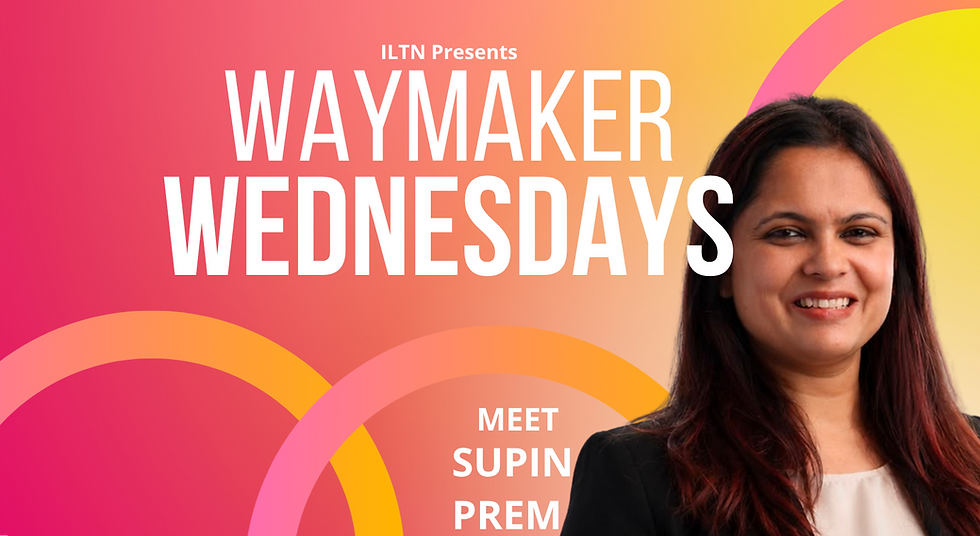
We’re kicking off our new Waymaker Wednesdays series, a space to spotlight the incredible women shaping LegalTech and learn more about their journeys, passions, and inspirations.
This week, we’re excited to introduce Lavanya G., a legal innovator who believes in the power of learning, empathy, and creativity.
We’re thrilled to introduce Lavanya Gunda, Founder & Designated Partner, Saham Legal LLP, and an active member of the Women in LegalTech community under ILTN. Lavanya combines her legal expertise with a passion for design, empathy, and innovation, making her a standout voice in reimagining how law can be delivered and experienced.

Here’s a peek into her world:
1. What inspired you to join the Women in LegalTech community?
I’ve always been deeply enthusiastic about learning, and during my time in the United States, I was introduced to the concept of continuing legal education; something that’s largely absent in Hyderabad or India. I realized that the best way to grow was by surrounding myself with the right people and engaging in conversations that challenge the way we think about law. That’s what drew me to join communities like the LegalTech group: to learn from practicing lawyers who are doing things differently, discovering technologies I hadn’t encountered before, and hearing real impact stories. If I can learn from their journey a little earlier, save time, and implement those insights faster, that, to me, inspired me to be part of the LegalTech community.
2. If you could solve one problem in the legal world (or beyond) with technology, what would it be?
Technology Can Enable Experiencing Empathy. In a series called The Good Fight, there is a case where a woman sues ChumHum, a big tech search engine and internet services company, after being assaulted in virtual reality while wearing a bodysuit. The judge puts on the suit himself, experiences what she went through, and immediately understands her sense of violation. For me, that shows how technology can create empathy. Before taking up a matter or delivering a judgment, if one could actually experience a situation—even virtually—it could create a far deeper impact. It is easy to say “I understand,” but technology might actually let us feel it in real time."
3. What’s one book, podcast, or resource that’s made a big impact on how you think about work or life?
A book that I really enjoyed and actually implemented is Rituals for Work: 50 Ways to Create Engagement, Shared Purpose, and the Culture of Bottom-up Innovation by Kursat Uznick and Margaret Hagen. It has very simple exercises that helped me bond more with my family and also create engagement with interns and employees. For example, one ritual called Airplane Mode Afternoon is about creating a distraction-free zone for work. Another exercise I tried was asking everyone to share the meaning of their name and a funny story behind it, which helped the interns and employees bond instantly. I also made them walk around the block, observe legal aspects, click pictures, and connect them to laws or case laws.
These small rituals from the book helped me build a more creative and connected work environment. I found the podcast I Will Teach You To Be Rich by Ramit Sethi very impactful because it gave me a real sense of direction in financial planning, something rarely taught in school, and it completely changed the way I think about money.
Another resource that really had an impact on me is the talks by Arthur C. Brooks, who teaches the science of happiness at Harvard. He explains that happiness comes from three macronutrients: enjoyment, satisfaction, and meaning. I often wonder what drives lawyers to take on other people’s problems, despite the friction and anger that comes with it, and in that search I stumbled upon his work. It helped me think about happiness differently and also reflect on what motivates lawyers to keep doing what we do.
4. Outside of work, what’s something you’re passionate about or love spending time on?
Outside of work, I love exploring design, whether it is mastering Figma, using Notability for
creative note-taking, or experimenting with Procreate to doodle case laws and play with brushes and colors. I also occasionally dive into concepts like sketchnoting, a form of visual note-taking I have practiced since before law school, and explore different design tools and short courses to keep improving a little every day.
5. What’s the best piece of advice you’ve ever received as a woman in your career journey?
My dad always advised me to take the client along with me in their legal journey, to empathize with them, understand their problem, and give them clarity and transparency, so they can see the effort and attention we give, which helps build trust and a stronger relationship.
6. If you weren’t working in law/legaltech, what’s another path you could totally see yourself in?
If not in law or legal tech, I would be an artist, using art to communicate issues that impact human life, values, and society.
Through her curiosity, empathy-driven vision, and creative spirit, Lavanya shows us what it means to be a true waymaker. At Women in LegalTech, we’re excited to continue highlighting members like her, women who are redefining what law and technology can achieve together.
Are you a woman shaping the future of legal tech? We’d love to hear your story. Our Women in LegalTech community is a space to connect, inspire, and spark conversations that matter. Click here to join and be part of the movement.


Do Not Appease Women
Don’t Take It So Seriously
Game Works, Get Off The Bench And Play
Donlak And HeManimal – At The Paradigm Shift
Broken Political Scene
Are Girls Really Crazy?
Always Be Moving Forward
The Womanizer’s Truth