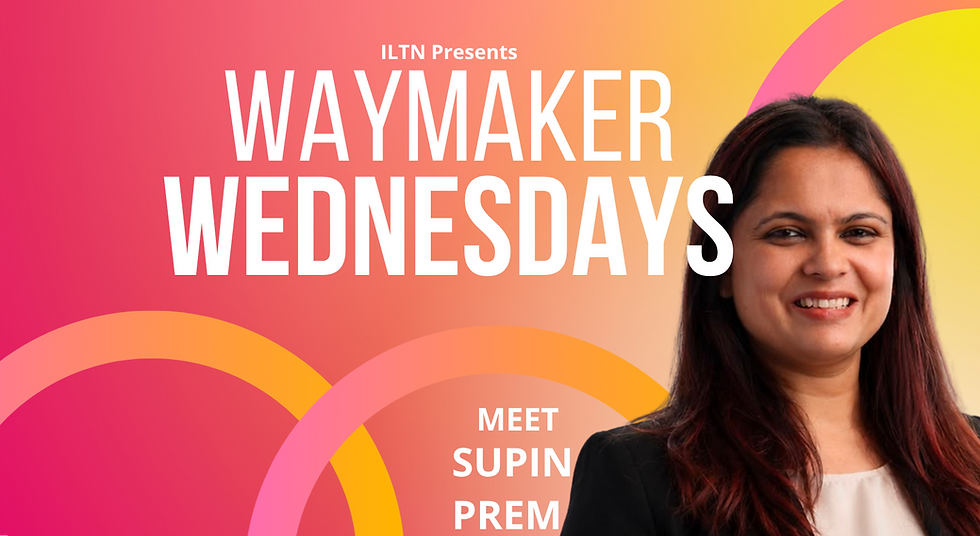
Waymaker Wednesday: Women in LegalTech – Meet Shubhangi Bhargava

Updated: Mar 18
Shubhangi Bhargava works at the intersection of law, technology, and human rights. She is currently Legal, Policy and Advocacy Manager at CADRE ODR, where she works on advancing dispute resolution through policy, research, and strategic advocacy.
Her work spans legal research, human rights advocacy, and innovation in justice systems. Prior to joining CADRE ODR, she worked with the United Nations and International Committee of Red Cross as a Research Consultant on judicial protection of victims and witnesses of conflict-related sexual violence. She has also contributed to justice and access-to-rights initiatives with the National Legal Services Authority (NALSA), the Commonwealth Human Rights Initiative’s Prison Reforms Programme, and through legal leadership roles at Prakruthi NGO, where she worked on women’s and children’s rights, legal research, and strategic litigation.
Shubhangi’s work focuses on the intersection of law, technology, and human rights, with particular interest in AI governance, strategic litigation, prison reform, missing persons and enforced disappearances, and access to justice. She holds a B.L.S. LL.B. from Government Law College, Mumbai, and a Master’s in International Humanitarian Law and Human Rights from the Geneva Academy.

Here’s a peek into her world:
1. What inspired you to join the Women in LegalTech community?
In my journey so far, I have been fortunate to have people cheering me on and many of those voices have been women! They have been courageous enablers, motivating in unseen and immeasurable ways! The women in the LegalTech community felt like a natural extension of that spirit. As someone curious about the intersection of Law and Tech, I was excited to join a space that is focused on the same and brings together stellar women innovating and doing incredible work in the field. I joined to learn, stay close to what is evolving in the field, and be part of a community where we can support each other along the way.
2. If you could solve one problem in the legal world (or beyond) with technology, what would it be?
If I could help solve one problem, it would be hunger. The idea that someone has to go to bed hungry really unsettles me. I know it sounds like a huge problem to even think about solving , but even contributing in a small way towards it would feel meaningful.
I have recently been reading Ending Hunger: The Quest to Feed the World Without Destroying It, which talks about how hunger is often less about the lack of food and more about how systems work - distribution, access, and coordination.
If technology could help strengthen those systems even in small ways so that food reaches the people who need it, that would be something worth working towards.
3. What’s one book, podcast, or resource that’s made a big impact on how you think about work or life?
One of the best books I have read is The Surrender Experiment by Michael A. Singer. It conveys a powerful idea. It says - instead of constantly asking “What do I want from life?”, ask “What does life want from me right now?” and then fully participate in it without resisting whatever is unfolding.
Before reading the book, whenever someone would say “we need to just accept things as they are,” it always sounded a bit stupid to me, like one of those philosophical ideas that sounds nice in theory but is impossible to practice in real life. But the book reframed it in a very interesting way. It is more about flowing with where life is taking you as it unfolds.
There is a line in the book that really stayed with me: Would it be fun to know the ending of a movie even before you start watching it? Probably not. And life is a lot like that: the beauty is in not knowing what comes next.
On a side note, I also love The Little Prince. It would feel unfair not to mention it.
4. Outside of work, what’s something you’re passionate about or love spending time on?
I have always loved poetry. For me, it is the most comfortable way of expressing myself. I also find a lot of solace in reading or listening to it. Poetry has this beautiful way of making you feel like you are not the only one experiencing a certain emotion, and somehow there is always a poem that speaks to whatever stage of life you are in. I write poetry myself in Hindi, English, and Urdu.
I love playing board games, going to the gym and doing yoga. And one of my favourite things is also having long conversations about life , reflecting on how you have grown up, the choices you have made, and where life is taking you. Especially with the few people who have seen my journey over the years - there is something special about growing together and continuing to grow alongside each other.
5. What’s the best piece of advice you’ve ever received as a woman in your career journey?
One very important person in my life once told me: learn to say no. Whenever you say yes when you actually want to say no, you are saying no to yourself. I wouldn’t say I have mastered this yet, but in the moments where I have been able to practice it, it has felt incredibly liberating. It’s a small but powerful way of being kinder to yourself.
Another piece of advice that has stayed with me is: perfection is the enemy of the good. It is something I remind myself of often especially when the mind plays its tricks to get everything exactly right and that starts slowing things down.
6. If you weren’t working in Law/LegalTech, what’s another path you could totally see yourself in?
I think I would still be drawn to the social impact and public policy space. Even within law and LegalTech, what really excites me is the possibility of improving systems, the scale of impact they can have, and making them work better for people. So I could easily see myself working more closely with policy and designing or building solutions for social problems.
But if I had to choose something completely different, intelligence and investigative work has always fascinated me. The idea of piecing together information, noticing patterns, and figuring out what is really going on behind the surface really intrigues me. A big part of that, I think, is also about understanding people, how they think and what motivates them. In many ways, it is like solving a puzzle made of human stories.
Shubhangi’s journey reflects how law, technology, and human rights can come together to address complex justice challenges. She continues to explore how research, policy, and innovation can create systems that are more responsive, inclusive, and human-centred.
Are you a woman shaping the future of legal tech? We’d love to hear your story. Our Women in LegalTech community is a space to connect, inspire, and spark conversations that matter. Click here


Comments